Are You Studying for the AFK Exam the Right Way? 5 Warning Signs You're Headed for Failure

Feb 14 / Mohamed Moussa
You've been studying for the AFK exam for weeks. You're putting in the hours. You're watching videos, reading notes, doing practice questions.
But here's the question that should terrify you:
Are you actually making progress, or just going through the motions?
Here's the uncomfortable truth: Most dentists who fail the AFK exam studied hard. They put in hours every day. They felt busy, productive, even confident.
The problem? They were studying wrong.
Over the past three years, we've analyzed study patterns from 127 dentists who failed the AFK on their first attempt. 
 We found something shocking:
91% of them had at least 3 warning signs they were studying ineffectively — but they ignored them.
In this guide, you'll learn:
The 5 critical warning signs your study approach is failing
How to measure real progress (not just hours logged)
When you can safely compress your timeline without killing your pass rate
The simple daily check-in that predicts exam success

The 3-Number Reality Check: Are You Actually Improving?

Most dentists track the wrong metrics. They count:
❌ Hours studied
❌ Videos watched
❌ Pages read
These numbers feel productive, but they're meaningless.
Here are the only 3 numbers that matter:
Number 1: Your Weekly Practice Test Score
What it should look like:
Week 1: 55-60% (baseline)
Week 4: 65-68% (early progress)
Week 8: 72-75% (solid foundation)
Week 12: 78-82% (exam ready)
Week 16: 85%+ (confident pass)
Reality check:
If your scores are stuck or declining, you're studying wrong — even if you're putting in 4 hours daily.

Dr. Ahmad's story:
"I studied 3 hours a day for 5 weeks and my practice scores went from 62% to... 63%. I was working so hard, but nothing was sticking. That's when I realized I was just reading passively, not actually learning."
Number 2: Your Wrong Answer Repeat Rate
How to track this:
Take the same 50-question practice test twice, one week apart.
What the numbers mean:
80%+ repeat errors = You're memorizing answers, not learning concepts
50-70% repeat errors = Shallow understanding, need better review

The killer insight:
If you're getting 75% on practice tests but repeating 70% of your errors, you're in serious trouble. You don't actually understand the material — you're just recognizing questions.

Number 3: Your "Explain It Back" Success Rate
The test:
Pick 10 questions you got wrong this week. Close your notes. Try to explain:
  1. Why the correct answer is right
  2. Why the wrong answers are wrong
  3. What concept the question is testing

Scoring:
Can explain 8-10 clearly = Solid understanding
Can explain 5-7 with some gaps = Surface learning ⚠️
Can explain 0-4 = Just memorizing, will fail

                This is the most honest measure you have.

If you can't explain it, you don't know it. And the AFK will expose that mercilessly.

Free Resources to Support Your Preparation 🎥📚🆓

We believe that every candidate should have access to high-quality learning materials, which is why we offer free resources to support your preparation for the AFK exam! 🌟🎯📖

Interactive Videos: Our expertly crafted videos explain key topics in an engaging, easy-to-understand format, helping you grasp essential concepts more effectively.

Question Bank with Detailed Answers: Practice with real exam-style questions and receive comprehensive explanations to strengthen your understanding and improve your problem-solving skills.

One-on-One Consultation: Need a study plan tailored to your unique needs? We offer personalized 1-on-1 sessions, where we assess your situation and learning preferences to recommend the best study strategies for your success. 🤝📈📅

These resources are designed to empower you with the knowledge and confidence needed to excel in the equivalency process. Take advantage of them and set yourself up for success! 🚀📚💡

🚩 Warning Sign #1: Your Practice Scores Plateaued or Declined

The symptom:
You've been studying for 4-6 weeks. Your practice test scores were improving steadily, then... they stopped. Or worse, they started dropping.
What this means:You've hit a learning ceiling with your current study method. More hours won't fix this — you need a different approach.
Why it happens:
  1. You're re-reading the same material (diminishing returns)
  2. You're not reviewing wrong answers properly
  3. You're studying breadth but not depth
  4. You've developed bad habits (memorizing patterns, not concepts)
The fix:
Stop studying new material immediately.
Spend the next 2 weeks exclusively on:
  1. Every question you got wrong in the last month
  2. Understanding WHY you got it wrong (not just the right answer)
  3. Finding 3 similar questions on the same concept
  4. Teaching the concept out loud to yourself

Expected result: Scores should jump 5-8% within 2 weeks.

🚩 Warning Sign #2: You're Scoring High on Easy Questions, Low on Hard Ones

The symptom:
Your practice tests show a pattern:
  • Straightforward recall questions: 85-90% correct
  • Application/case-based questions: 55-60% correct
What this means:
You can memorize facts, but you can't apply knowledge.
The AFK is 70% application questions. You're in trouble.

The deadly pattern:
"I know that Amoxicillin is 500mg TID for adults... but when they give me a case with a pregnant patient with penicillin allergy, I freeze."

The fix:
For every fact you learn, force yourself to answer:
When would I use this?
When would I NOT use this?
What are the contraindications?
What would I do in a complex case?

Example:
Shallow learning:
"Clindamycin 300mg QID for odontogenic infections"
Deep learning:
Clindamycin 300mg QID works for odontogenic infections
But NOT if patient has recent C. diff or inflammatory bowel disease
Alternative: Amoxicillin/Clavulanate UNLESS penicillin allergy
If pregnant with penicillin allergy: Azithromycin
If severe/spreading: Refer + IV antibiotics

See the difference?
Write your awesome label here.

Would you like to study smart not hard? 
Join the full course today

Unique learning paths
  • By engaging with our interactive platform, you will not only enhance your knowledge but also develop the resilience to handle any stress that comes your way
  • Not only that, but we also offer authentic exam-grade questions that are backed by evidence-based, fully explained answers.
  • Additionally, we offer MOCK exams to ensure that you are fully prepared for the real AFK exam. Join us now and unlock your true potential!

Never miss the news

Stay updated | Stay current | Stay connected

Thank you!

🚩 Warning Sign #3: You Can't Study Without Your Notes

The symptom: When you close your notes and try to recall information, your mind goes blank. You need your materials in front of you to answer questions.
What this means:
You're dependent on recognition, not recall. On exam day, you won't have notes. You'll panic.
The test:
Close everything. Write down from memory:
  • The 3 classes of malocclusion (Angle classification)
  • Differences between Type 1 and Type 2 diabetes medication adjustments
  • Steps in full mouth rehab treatment planning
    If you can't do this fluently, you're not ready — even if you scored 75% on your last practice test (because you had notes nearby).
Read a topic for 10 minutes
  1. Close notes
  2. Write everything you remember
  3. Open notes, check what you missed
  4. Wait 24 hours, write it again from memory

This feels slower and harder than passive reading.
That's the point. Difficulty = learning.
The fix:
Active recall practice, starting today:

🚩 Warning Sign #4: You're Studying Every Day Without Rest

The science:
our brain consolidates learning during rest. Students who study 6 days with 1 rest day retain 30-40% more than those who study 7 days straight.

Dr. Dania's story:
"I tried studying every single day for the first month and burned out hard. Switching to the 6-day schedule with intentional rest transformed my retention. I actually remembered more while studying less."
The fix:
Mandatory Sunday off.
No studying. No review. Complete mental break.
On that Sunday:
Sleep in
Exercise
Socialize
Do anything BUT dentistry
Expected result:
Your Monday scores will be 5-10% higher than your Saturday scores. Rest works.

Claim Your Free Readiness Assessment

Get the feel of the high yield notes:

  • Notes coming from textbooks covering the most important topics for AFK, you need nothing more than them to pass AFK. You don't need to waste your time getting the important information from the textbooks, I did that for you.
Write your awesome label here.

🚩 Warning Sign #5: You Don't Know Your Weak Areas
The symptom:

Someone asks: "What are you struggling with?"
You answer: "Um... everything? Pharmacology I guess? Maybe perio?"
You have a vague sense of difficulty, but no specific data.
What this means:
You're studying randomly, hoping to get better.
Hope is not a strategy.
The fix:
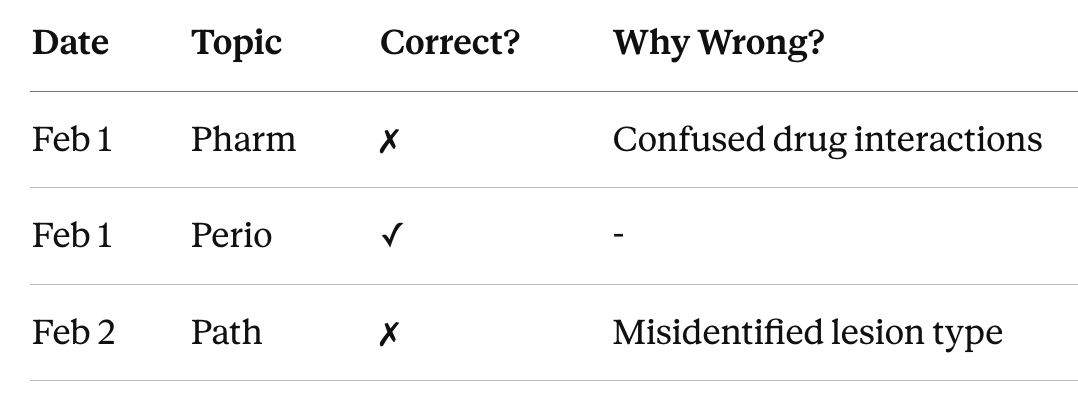
Track every practice question in a simple spreadsheet:
Within 2 weeks, patterns emerge. You'll see:
"I miss 80% of questions about drug interactions"
"I get periodontal diagnosis right but treatment wrong"
"I confuse lichen planus with pemphigus every time"

Now you have a targeted study plan instead of random review.

Your Action Plan: What to Do Right Now

✅ If You See 0-1 Warning Signs:
You're on track. Keep going.
To-do today:
  1. Calculate your 3 key metrics
    (practice scores, repeat rate, explain-back)
  2. Schedule your mandatory Sunday rest
  3. Track your next 10 practice questions by topic

⚠️ If You See 2-3 Warning Signs:
You're in the danger zone. Course correct immediately.
To-do this week:
  1. Stop new material for 3 days
  2. Deep review every wrong answer from the last 2 weeks
  3. Book a study strategy session (free consultation)
  4. Implement active recall practice starting tomorrow

🚨 If You See 4-5 Warning Signs:
You're headed for failure with your current approach.
To-do today:
  1. Stop everything
  2. Book emergency consultation to redesign study plan
  3. Consider postponing exam if less than 8 weeks away
  4. Get personalized feedback on your weak areas

Don't ignore this. 73% of failed candidates saw these signs and kept going anyway.

Final Thoughts: Trust the Data, Not Your Feelings

Here's what separates dentists who pass from those who fail:
Failed dentist:
"I feel like I'm learning. I'm putting in the hours. I hope I'm ready."
Successful dentist:
"My scores went from 68% to 76% this month. My repeat error rate dropped from 60% to 35%. I can explain 8 out of 10 concepts clearly. I'm ready."

But here's the good news:
Every one of these problems is fixable — IF you catch them early and take action.
The 342 dentists who passed our program weren't smarter than you. They just measured their progress honestly and adjusted when the data told them to.

You can do the same.

About the Author:

Dr. Mohamed is a licensed dentist in Canada who successfully passed both AFK and ACJ exams. After seeing too many talented international dentists fail due to poor study strategies, he created AFKStudyPlan to provide structured, evidence-based preparation. He's helped 342+ dentists pass their NDEB equivalency exams.
Have questions?
Email us at Info@afkstudyplan.com
or call 587-707-7068.

Frequently Asked Questions 

Q1: I'm studying 4 hours daily but my scores aren't improving. What's wrong?

A: You're likely doing passive studying (reading, watching) instead of active studying (practicing, explaining). Switch to 70% practice questions and 30% reviewing wrong answers. Your scores should improve within 2 weeks.

Q: How do I know if I should compress my timeline or extend it?

A: Take a full-length mock exam right now. If you score below 70%, you need the full timeline (or longer). If you score 75%+, compression might work — but only if you can study 4-5 focused hours daily.

Q: My practice scores went from 70% to 65%. Should I panic?

A: One test dip isn't panic-worthy. But if your 3-test average is declining, yes — change your approach immediately. This usually means you're tired, not reviewing mistakes properly, or studying the wrong way.

Q: Can I recover if I've been studying wrong for 6 weeks?

A: Yes! Many of our successful students had to reset their approach mid-preparation. The key is catching it now rather than on exam day. Book a consultation and we'll help you redesign your plan.