Sep 20 • AFK study plan

Ace Your Boards: The Fundamentals of Dental Materials

Understanding the physical and chemical properties of dental materials is not merely an academic exercise; it is the strategic foundation of successful restorative dentistry. For the clinician, mastery of these principles—from atomic architecture to macro-mechanical behavior—is the prerequisite for predicting how a material will perform under the relentless physiological, thermal, and electrochemical stresses of the oral cavity. This guide synthesizes the core concepts necessary for clinical excellence and success in high-stakes board preparation, such as the AFK and NBDE.

🎁 Your FREE AFK High-Yield Guide Is Ready!

Get instant access to a high-yield AFK PDF packed with important concepts, key facts, and exam-focused information you need to know.
📘 Study smart. Focus on what matters. Build your confidence.
Good luck with your AFK journey! 🦷💙
Enter your email to get your FREE PDF instantly.
Write your awesome label here.

1. Molecular Architecture: The Power of Interatomic Bonds
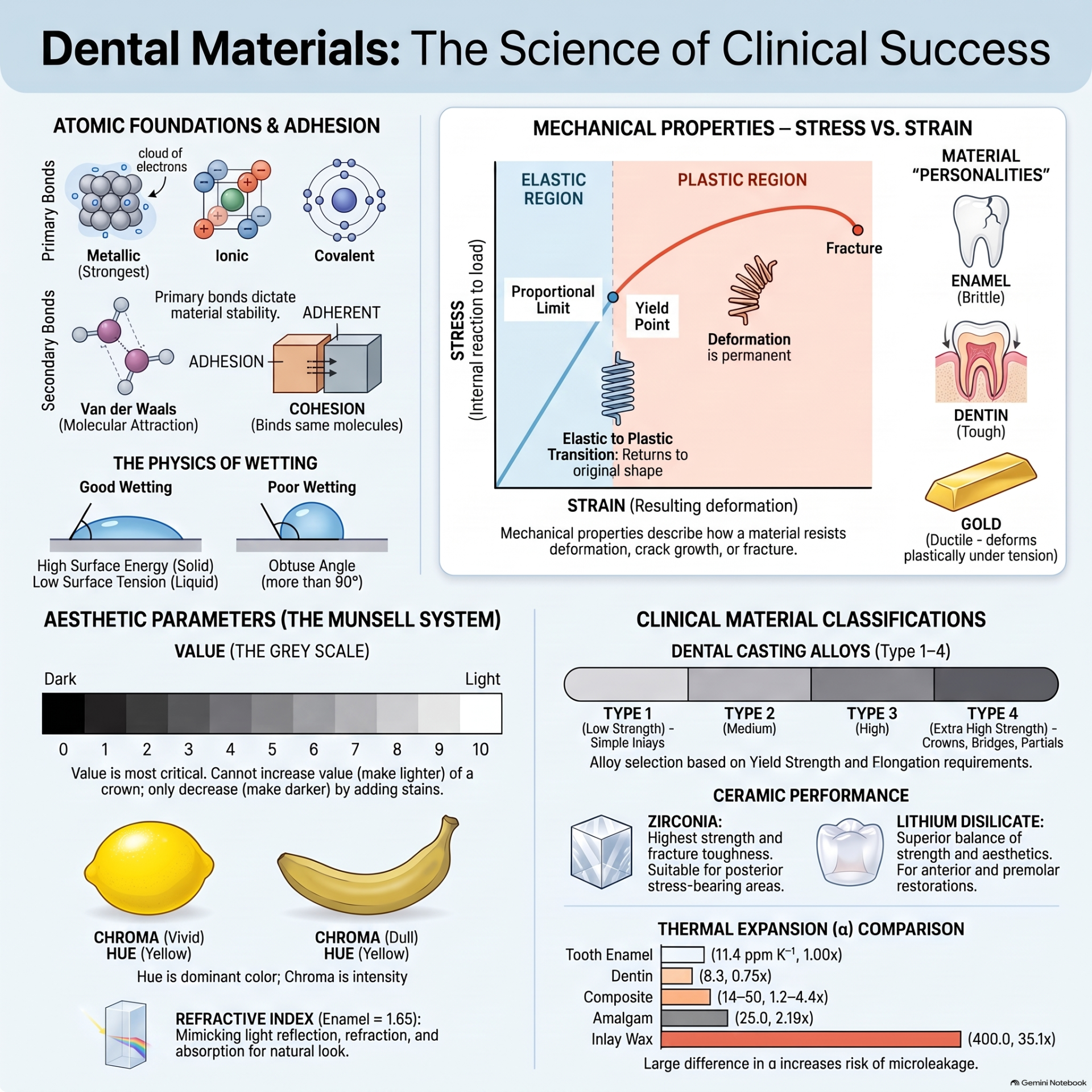
The clinical behavior of any restorative material is a direct reflection of its internal atomic structure. By understanding interatomic bonding, we can anticipate a material's stability and its reaction to the oral environment.
 Primary vs. Secondary Bonds Analysis
Materials are held together by two categories of bonds. Primary bonds are the strongest, involving electron transfer or sharing. Secondary bonds (Van der Waals forces, Hydrogen bonds) involve dipole attractions and repulsions without electron sharing.
Primary bonds are categorized into three types:

Ionic Bonds: 

A classic recipient-donor relationship where one atom donates an electron to another (e.g., Sodium Chloride).

Covalent Bonds: 

Atoms share electrons in highly precise orientations, creating stable chemical compounds.

Metallic Bonds: 

Found in dental alloys, these are characterized by a unique mechanic:
- The Electron Cloud or "Gas": Shared valence electrons are not fixed; they move freely throughout the metal space lattice, forming what is described as an "electron gas."
- High Energy Requirement: This cloud/gas binds the positively charged nuclei so effectively that an insane amount of energy is required to disrupt these bonds compared to ionic or covalent structures.

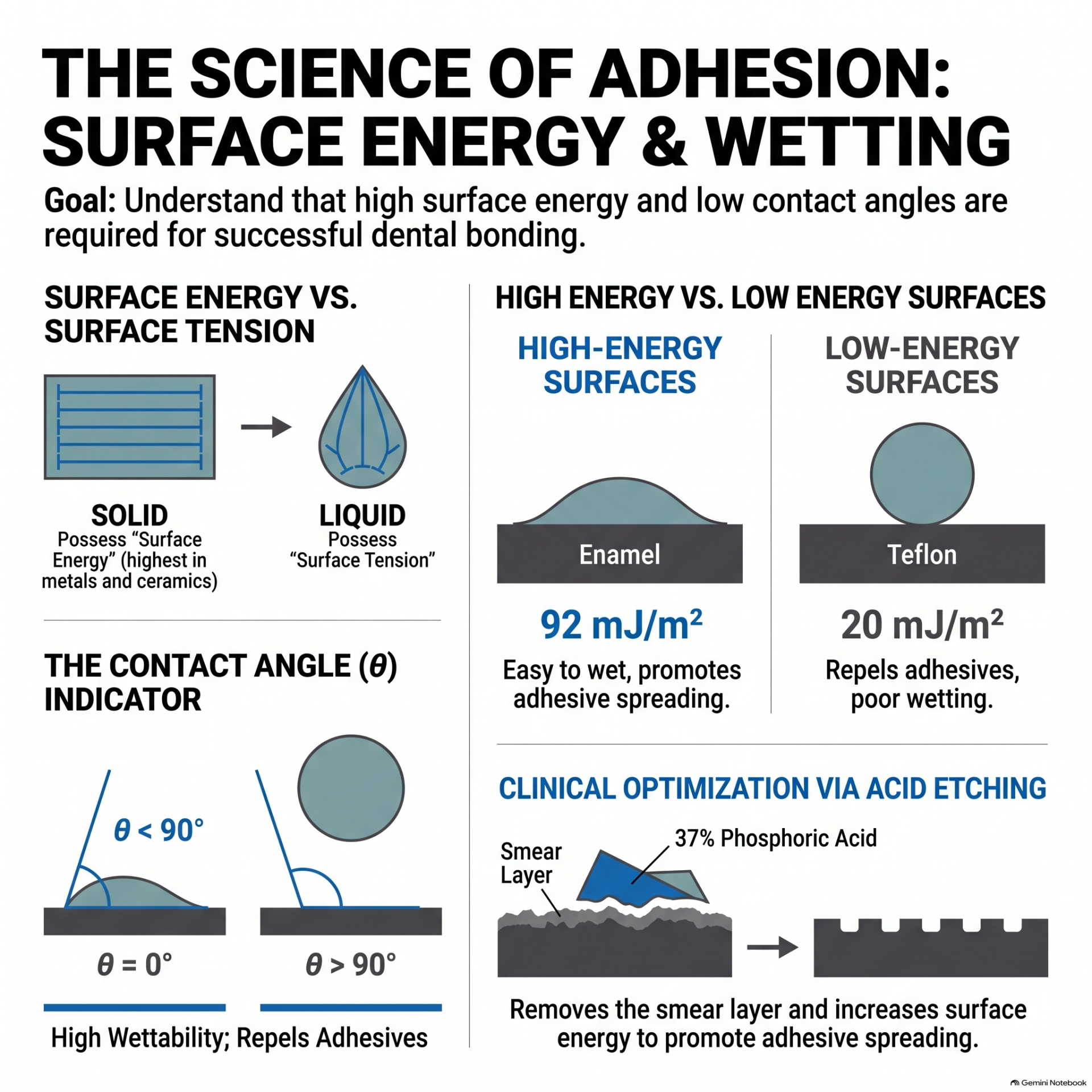
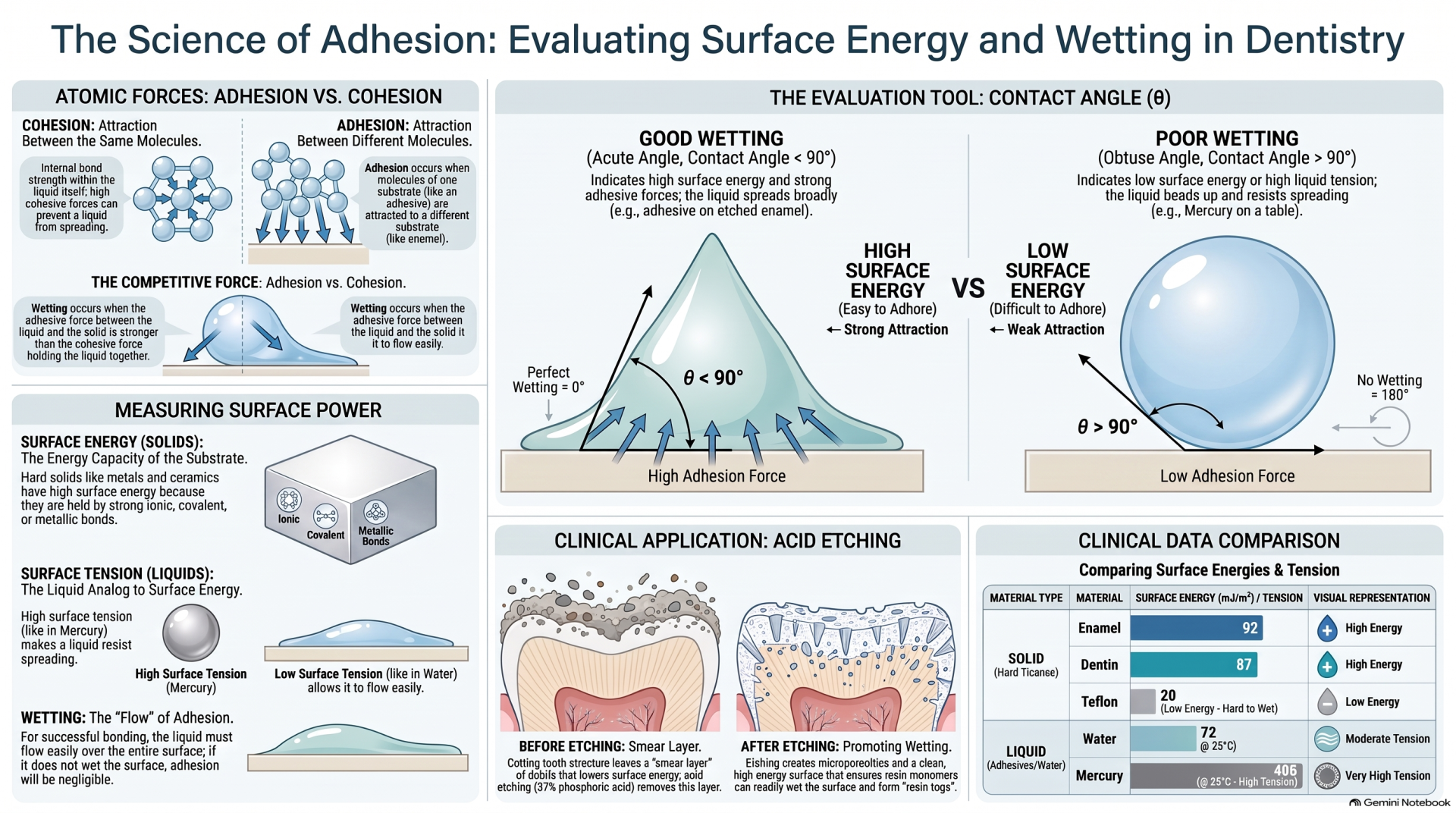
2. Evaluating Surface Energy and Wetting
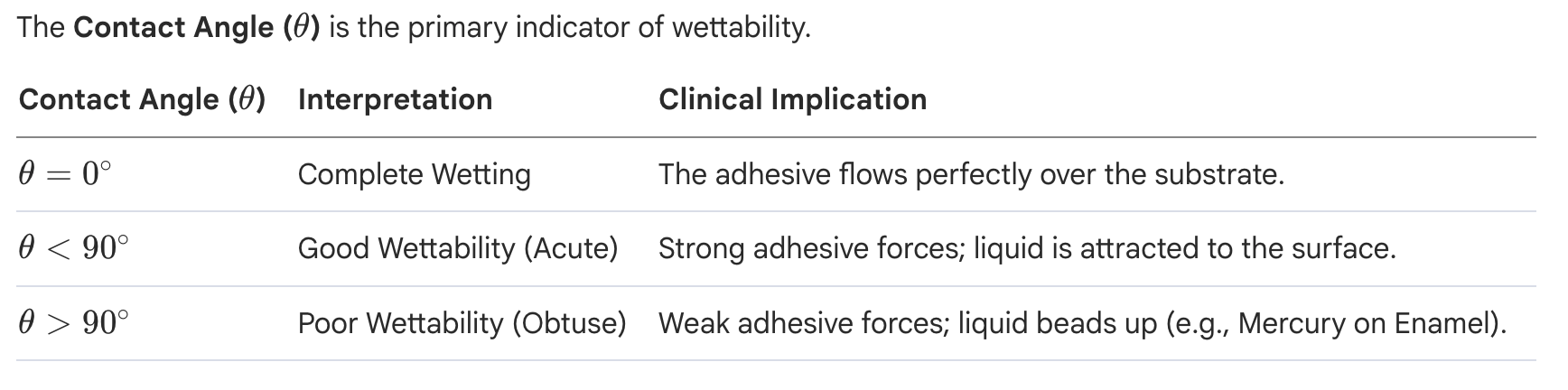
A material’s ability to "wet" a surface depends on the competition between the solid's Surface Energy and the liquid's Surface Tension. Hard solids like metals and ceramics possess high surface energy due to their strong primary bonds, which aggressively attract liquids.
Clinical Strategy Note: Surface cleanliness is a major prerequisite for high surface energy. Impurities lower surface energy, yielding a surface that resists wetting and prevents an effective bond.

Free Resources to Support Your Preparation 🎥📚🆓

We believe that every candidate should have access to high-quality learning materials, which is why we offer free resources to support your preparation for the AFK exam! 🌟🎯📖

Interactive Videos: Our expertly crafted videos explain key topics in an engaging, easy-to-understand format, helping you grasp essential concepts more effectively.

Question Bank with Detailed Answers: Practice with real exam-style questions and receive comprehensive explanations to strengthen your understanding and improve your problem-solving skills.

One-on-One Consultation: Need a study plan tailored to your unique needs? We offer personalized 1-on-1 sessions, where we assess your situation and learning preferences to recommend the best study strategies for your success. 🤝📈📅

These resources are designed to empower you with the knowledge and confidence needed to excel in the equivalency process. Take advantage of them and set yourself up for success! 🚀📚💡

3. Mechanical Properties: Navigating the Stress-Strain Curve
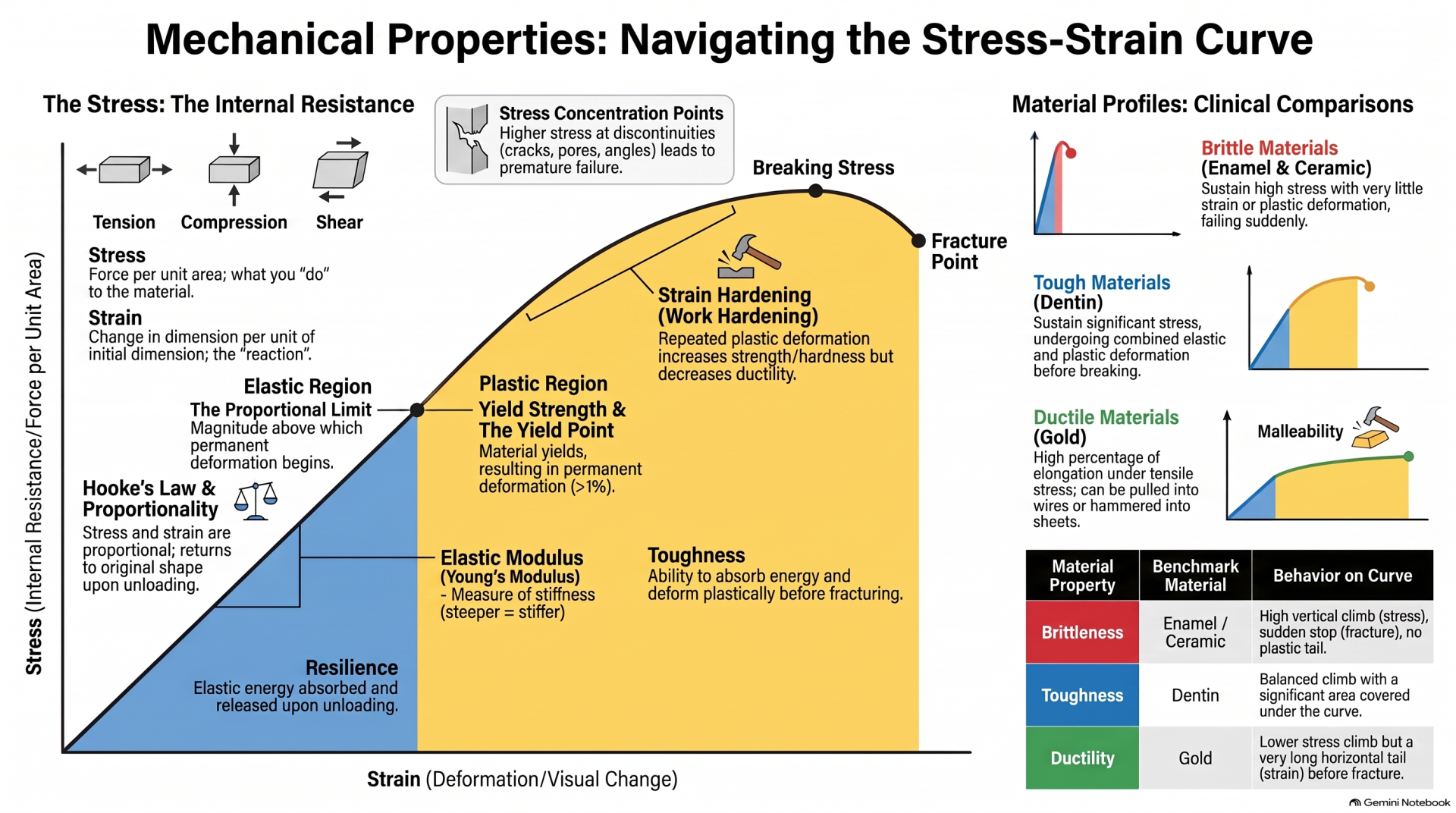
Understanding how materials deform under masticatory loads is essential for preventing fracture.
Stress: Force per unit area.
Strain: Change in dimension per unit initial dimension.
Resilience: Often used as a synonym for the elastic strain energy stored within a material. It represents the material's ability to absorb energy when deformed elastically and release it upon unloading.
The Proportional Limit and Yield Point:
In the Elastic Region, materials follow Hooke’s Law (proportional stress and strain). The Yield Point (Elastic Limit) is the "So What?" factor: it is the transition from reversible change to Plastic Deformation—permanent, irreversible damage.
Material Classifications
Brittle: High resistance to stress but low strain. These fracture suddenly with no plastic deformation (e.g., Enamel, Ceramics).
Ductile: Materials that undergo large plastic deformation/elongation before breaking (e.g., Gold).
Tough: Materials with high resistance to both elastic and plastic deformation, absorbing significant energy before failure (e.g., Dentin).
Concluding Clinical Tip
Restorative success requires integrating these principles. A material with the correct Hue is useless if its Coefficient of Thermal Expansion causes leakage, or if its Brittle nature leads to fracture because the load exceeded its Proportional Limit. Always aim to mimic the Toughness of dentin and maintain Surface Cleanliness for high surface energy to ensure a predictable clinical outcome.

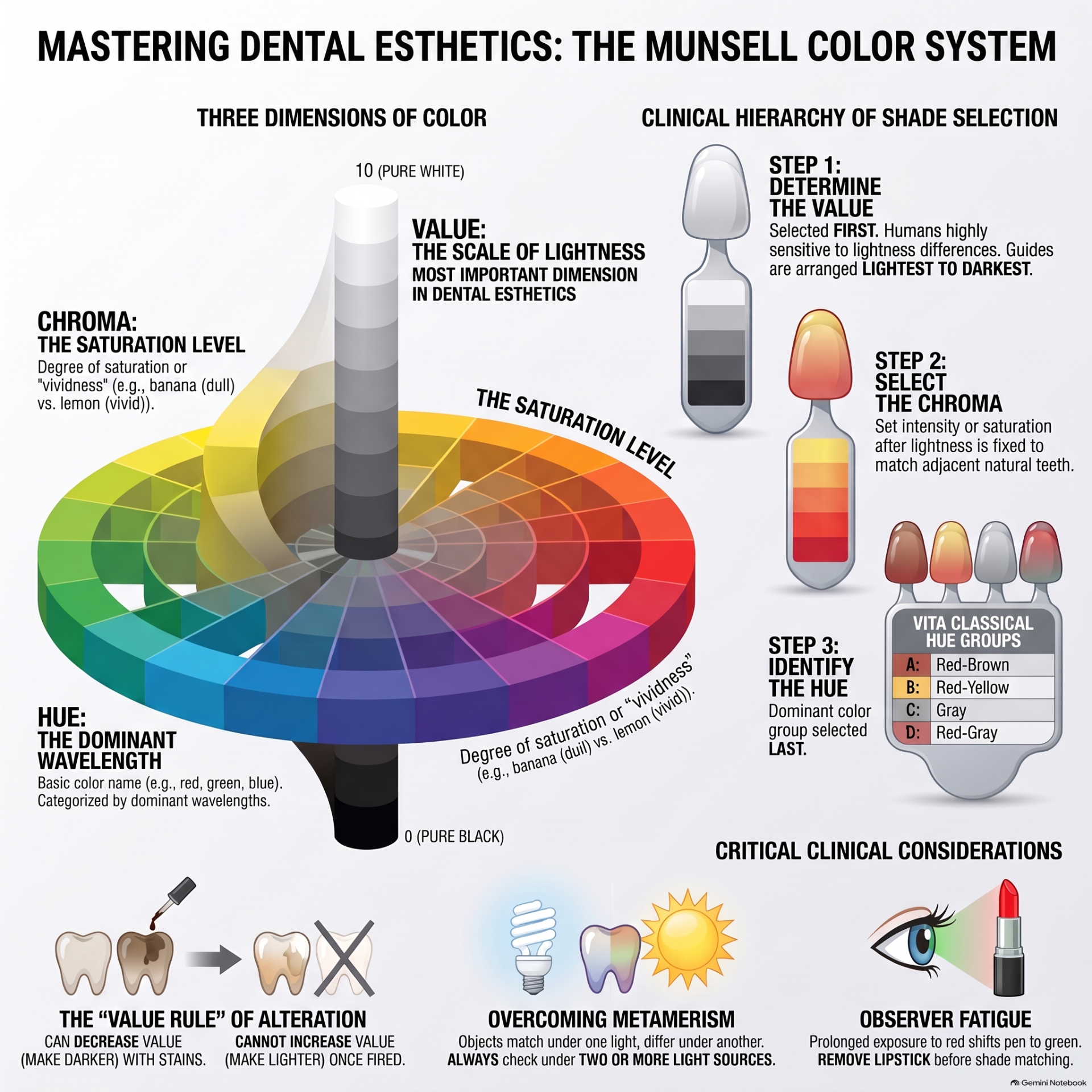
3. The Esthetics Layer: Munsell Color Theory in the Clinic
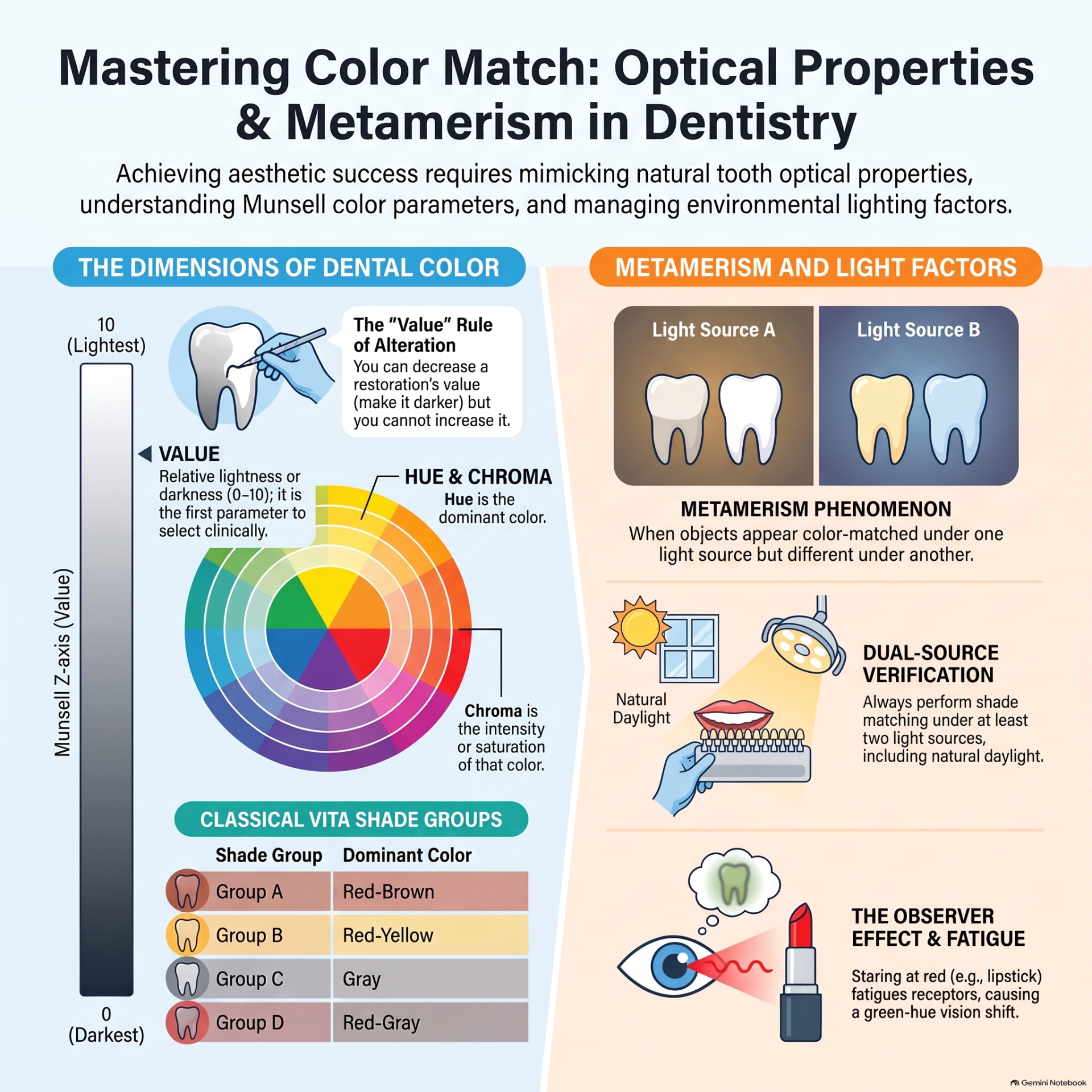
Mimicking natural enamel requires an understanding of light interaction (refraction, reflection, absorption, and transmission). With an Enamel Refractive Index of 1.65, the tooth is a complex optical target. We use the Munsell Color System to standardize this.
The Dimensions of Color
1- Value (The Priority): The relative lightness or darkness (Gray Scale). Clinically, you must select Value first. You can decrease value with stains, but you cannot increase the value (make it lighter) of a fired ceramic crown.
2- Hue: The dominant wavelength (e.g., A-series is red-yellow, B-series is yellow).
3- Chroma: The intensity or saturation (e.g., the vivid yellow of a lemon vs. the dull yellow of a banana).

Clinical High-Yield Tips:
Metamerism: The phenomenon where objects match under one light (clinic fluorescent) but differ under another (daylight). Always verify shades under at least two light sources.
Retinal Fatigue: Looking at red objects (like a patient's lipstick) for too long causes the observer to see a green hue. Clinically, this mandates the removal of red lipstick before shade selection.

About the Author:

Dr. Mohamed is a licensed dentist in Canada who successfully passed both AFK and ACJ exams. After seeing too many talented international dentists fail due to poor study strategies, he created AFKStudyPlan to provide structured, evidence-based preparation. He's helped 342+ dentists pass their NDEB equivalency exams.
Have questions?
Email us at Info@afkstudyplan.com
or call 587-707-7068.

Latest from our blog