Oct 1 • AFK study plan

Restorative Dentistry Unlocked: Amalgam, Composites & Bases

Navigating the vast landscape of dental biomaterials can feel overwhelming, but success on board exams and in daily operative clinic comes down to mastering three primary restorative pillars. In this second installment, we focus exclusively on direct restorations and pulp protection: Dental Amalgam Metallurgy, Composite Resin Adhesion, and Cements, Liners & Bases.Whether you need a quick refresher on eliminating the $\gamma_2$ phase in amalgams, the amphiphilic role of HEMA in hybrid layer formation, or why eugenol is strictly contraindicated under composite resins, this high-yield review distills complex chemistry into actionable clinical insights.

🎁 Your FREE AFK High-Yield Guide Is Ready!

Get instant access to a high-yield AFK PDF packed with important concepts, key facts, and exam-focused information you need to know.
📘 Study smart. Focus on what matters. Build your confidence.
Good luck with your AFK journey! 🦷💙
Enter your email to get your FREE PDF instantly.
Write your awesome label here.

1- Dental Amalgam: Metallurgy, Tarnish, and the Corrosion Lifecycle
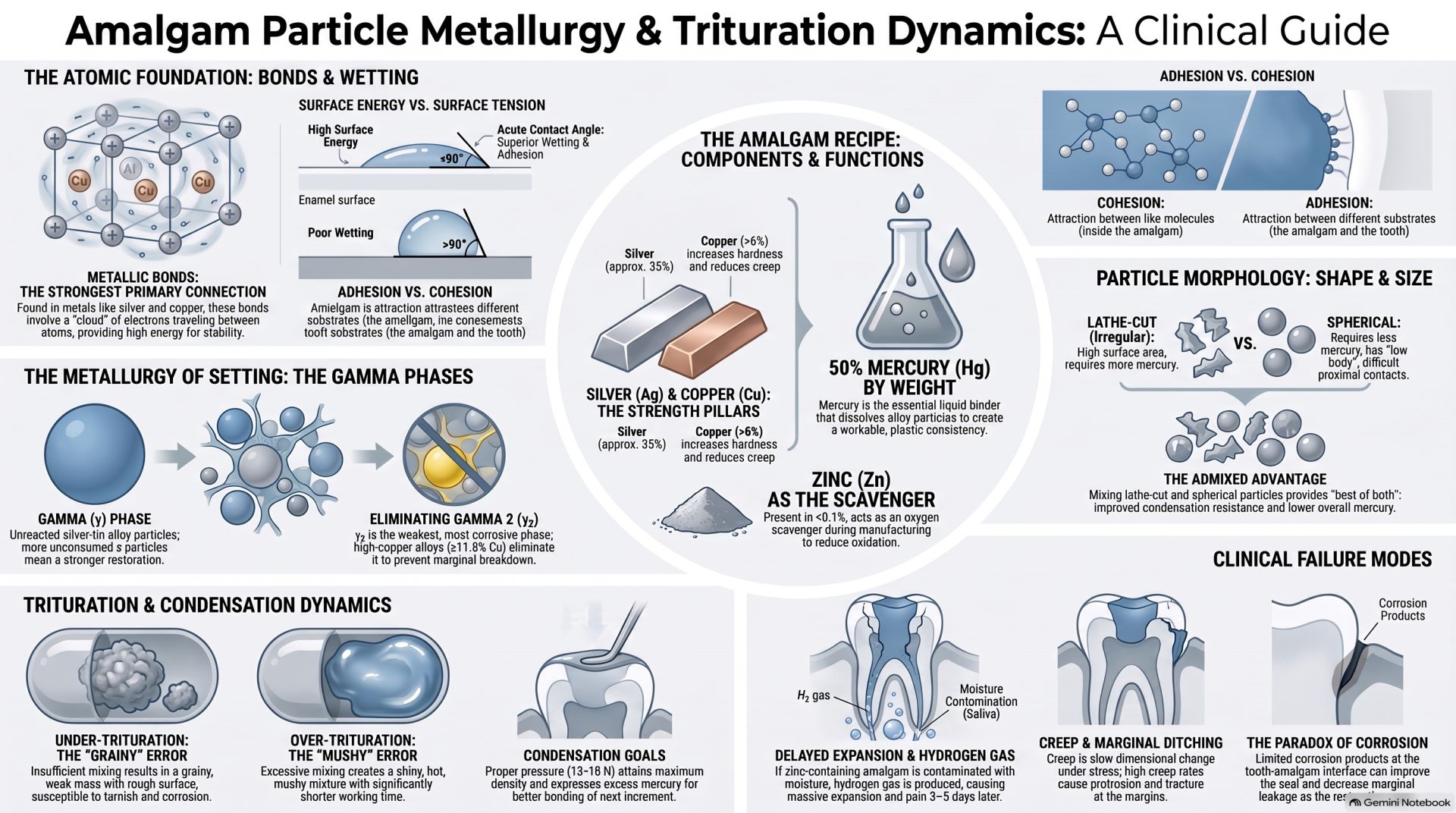
The oral cavity is a harsh electrochemical environment that functions as a battery. For any metallic restoration to survive, you must manage its interaction with saliva, which acts as an electrolyte. Understanding the electrochemical deterioration of amalgam is not optional—it is a requirement for longevity.
The deterioration process is defined by the Gamma-2 Phase. In the metallurgy of amalgam, the Gamma-2 phase is the most susceptible to electrochemical attack. This phase leads to the leaching of ions into the oral environment, causing the structural disintegration of the restoration. Clinically, you must recognize that tarnish is the "forerunner" of this destruction. While tarnish is merely a surface film (often oxides or sulfides), it creates the environment necessary for corrosion to begin its catastrophic attack. Clinicians should warn patients that sulfur-containing foods, such as eggs, significantly accelerate this tarnish-to-corrosion lifecycle.

💡 Board Exam Prep: Galvanic Shock

The examiner will expect you to define Galvanic Shock. This occurs when dissimilar metals (e.g., a gold crown opposing an amalgam) meet. Saliva acts as the electrolyte, allowing ions to leach and creating an electric current that travels through the restorations into the pulp. This results in sharp "pulpal pain" that mandates material re-evaluation.

2- Composite Resins and the Science of Adhesion: Wetting the Hybrid Layer
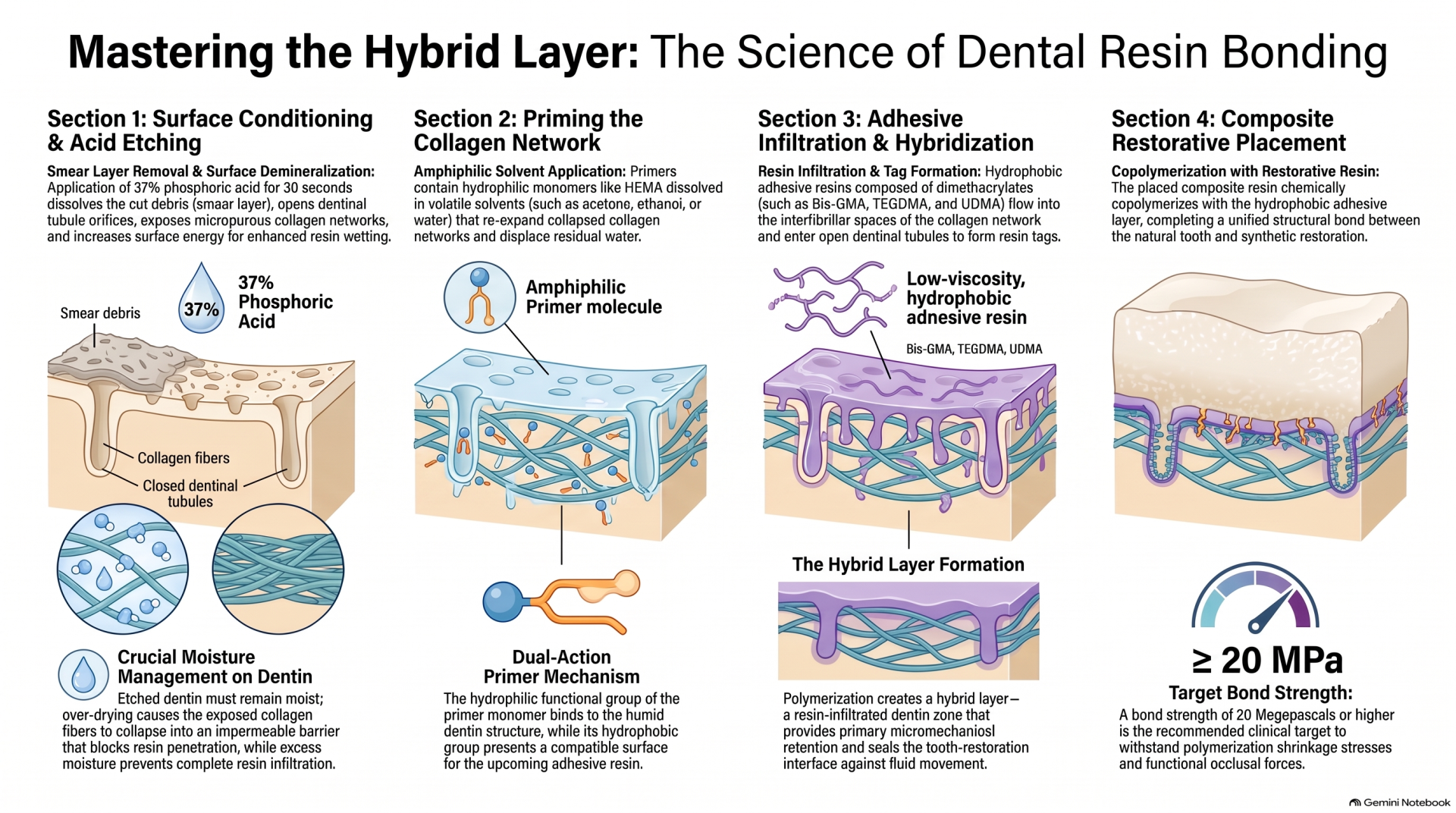
Reliable bonding is not achieved by chance; it is the result of managing surface energy and contact angles. To achieve a high-integrity "Hybrid Layer," the adhesive must "wet" the tooth structure, flowing into every microscopic irregularity.

The Hierarchy of Surface Energy
The ability of a solid to be wetted is determined by its surface energy. High-energy solids (metals, ceramics, and enamel) possess strong chemical bonds that actively attract liquid molecules.
Enamel (92 mJ/m²): Higher surface energy; easier to wet and bond.
Dentin (87 mJ/m²):Lower surface energy; presents a greater challenge for reliable adhesion.

The Mechanics of the Contact Angle
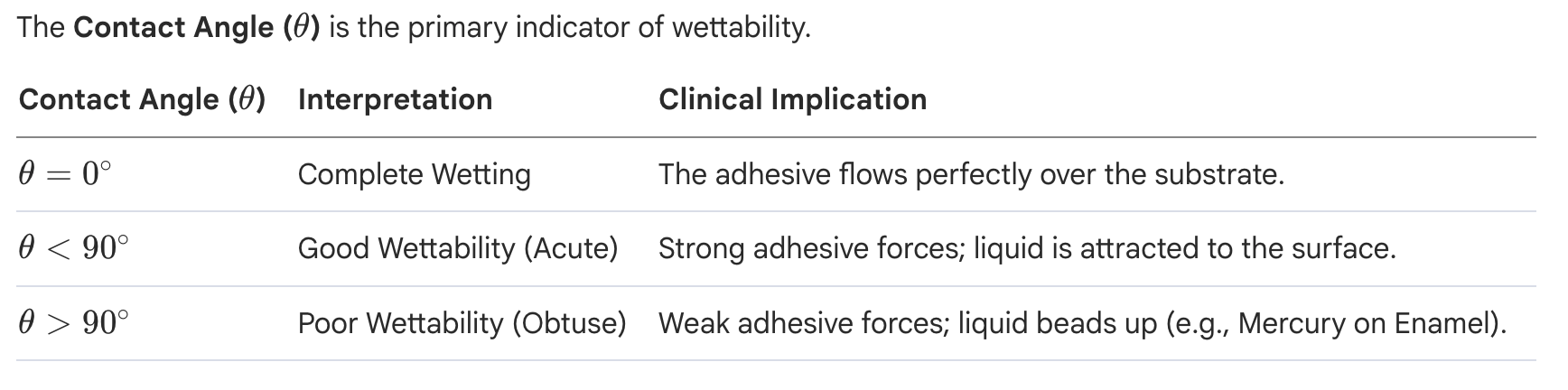
The Contact Angle (θ) is your primary indicator of wettability. Clinically, this mandates that you understand these three states:
1. Acute Angle (Less than 90°): Indicates good wettability; adhesive forces outweigh cohesive forces.
2. 0° Angle: Represents complete wetting, where the liquid spreads perfectly across the surface.
3. Obtuse Angle (more than90°): Indicates poor wettability; the liquid beads up (e.g., mercury on enamel).

Strategic Move:
You must ensure absolute surface cleanliness. Impurities significantly lower the surface energy of enamel and dentin, leading to "poor adhesive wet-out" and the clinical failure of the bond.

Free Resources to Support Your Preparation 🎥📚🆓

We believe that every candidate should have access to high-quality learning materials, which is why we offer free resources to support your preparation for the AFK exam! 🌟🎯📖

Interactive Videos: Our expertly crafted videos explain key topics in an engaging, easy-to-understand format, helping you grasp essential concepts more effectively.

Question Bank with Detailed Answers: Practice with real exam-style questions and receive comprehensive explanations to strengthen your understanding and improve your problem-solving skills.

One-on-One Consultation: Need a study plan tailored to your unique needs? We offer personalized 1-on-1 sessions, where we assess your situation and learning preferences to recommend the best study strategies for your success. 🤝📈📅

These resources are designed to empower you with the knowledge and confidence needed to excel in the equivalency process. Take advantage of them and set yourself up for success! 🚀📚💡

3- The Pulp Protection Hierarchy: Cements, Liners, and Thermal Dynamics
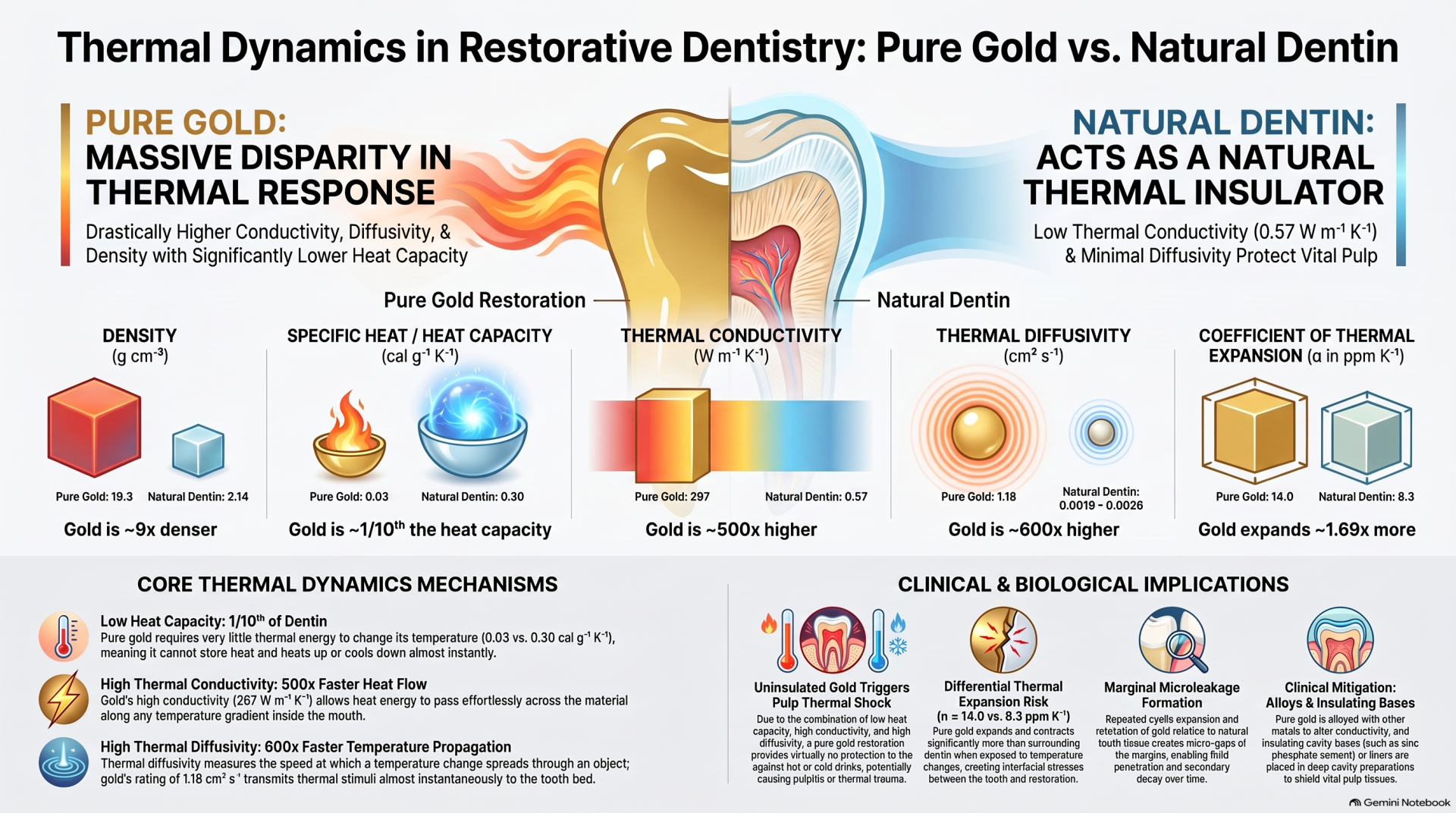
One of your primary clinical duties is to protect the vital pulp from thermal shock. You must appreciate the staggering disparity between the thermal properties of metallic restorations and natural dentin.

Thermal Dynamics: Gold vs. Dentin
Gold is an excellent conductor but a poor protector of the pulp:
Heat Capacity: Gold has only 1/10th the capacity of dentin (it does not store heat).
Thermal Conductivity: Gold is 500x more conductive than dentin.
Thermal Diffusivity: Gold is 600x faster at spreading temperature changes.

Because gold transmits thermal changes almost instantly, a pure gold filling offers zero protection. This mandates the use of insulating cements or liners like Zinc Phosphate or Glass Ionomer. Traditional agents like Zinc Phosphate utilize Micromechanical Bonding. The viscous fluid flows into the irregularities of the tooth and the crown's intaglio; once hardened, these "cementing material projections" provide the mechanical interlocking required for retention.

About the Author:

Dr. Mohamed is a licensed dentist in Canada who successfully passed both AFK and ACJ exams. After seeing too many talented international dentists fail due to poor study strategies, he created AFKStudyPlan to provide structured, evidence-based preparation. He's helped 342+ dentists pass their NDEB equivalency exams.
Have questions?
Email us at Info@afkstudyplan.com
or call 587-707-7068.

Latest from our blog